
Aderemi Ogunpitan
Executive Consultant at IBST Media • Media Technology Entrepreneur
30 June 2026 • 2 min read
The controversy surrounding the alleged Presidential Foreign Intervention Promotion Council extends beyond accusations against a single individual. It raises a much bigger question about how government operates and how public money is managed. Governments make mistakes. What matters is how quickly they explain them and how transparent they are in putting the facts before the public.
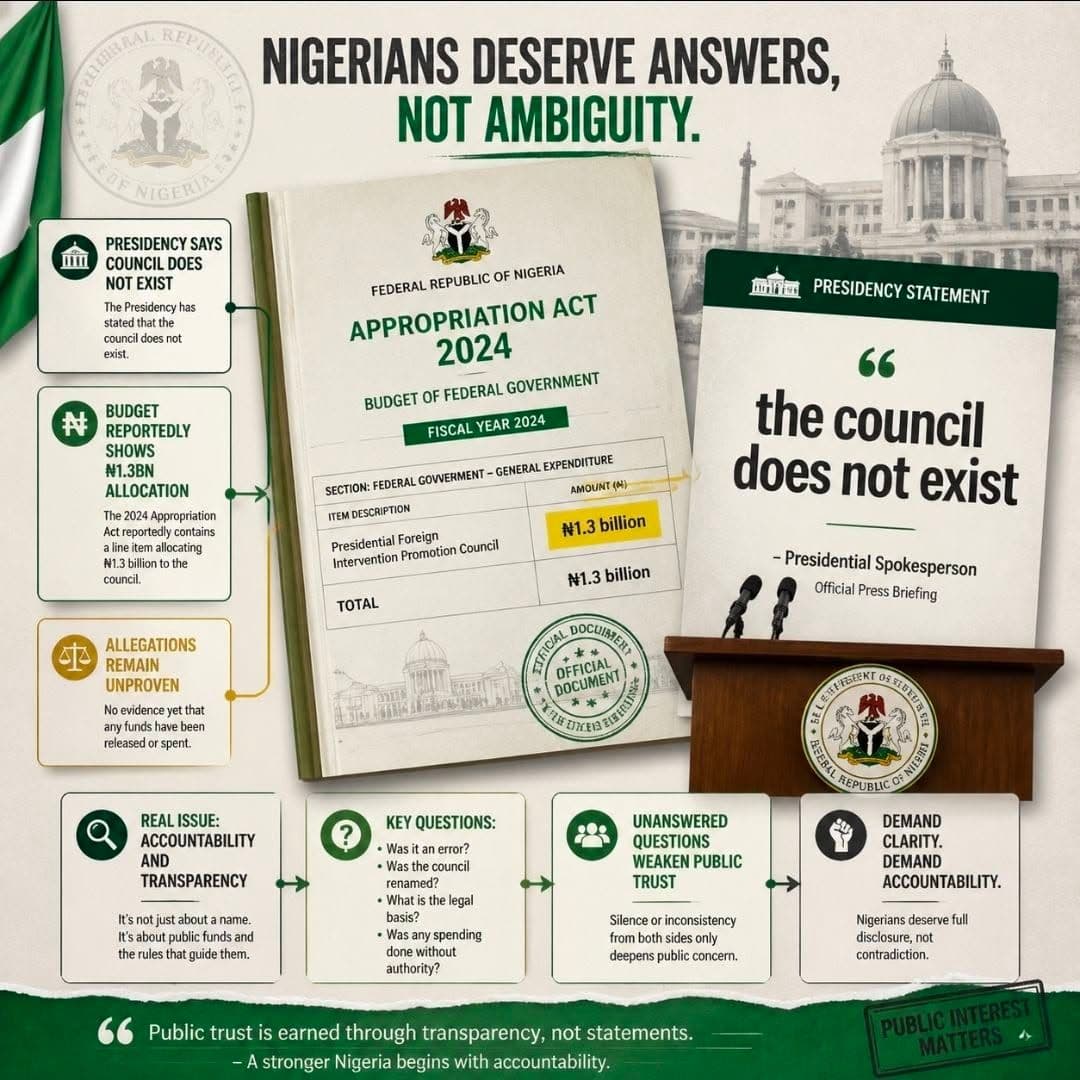
In this case, the Presidency publicly stated that the council does not exist and warned Nigerians to ignore anyone claiming to represent it. Ordinarily, that should have settled the matter. Instead, it opened another. Reports subsequently pointed to a budget allocation of about ₦1. 3 billion in the 2026 Appropriation Act for what appears to be the same council, alongside the Presidential Economic Advisory Council.
If that budget entry is accurate, Nigerians are entitled to ask a simple question: how does a body the government says does not exist end up with an allocation in the national budget? That is the real issue. The allegations of fraud, kickbacks and corruption made by a civil society organisation are serious, but they remain allegations.
They have not been proven in court, and no anti-corruption agency has publicly announced criminal charges. It would therefore be wrong to present those claims as established fact. The budget discrepancy, however, is different. It is a governance issue that deserves a clear and documented explanation. Was it an administrative error? Was the council created but never formally announced? Was it renamed?
Or was public money appropriated for an entity that had no legal basis? These are not political questions. They are questions of accountability. The longer those questions remain unanswered, the more damaging the episode becomes for the government. Public confidence depends on consistency. When official statements, budget documents and public records appear to contradict one another, trust begins to erode.
This is precisely why transparency matters. The government can resolve much of the controversy by publishing the relevant documents, explaining the budget entry, clarifying the legal status of the councils, and disclosing whether any funds were released or spent. Until then, the controversy remains less about proven corruption than about unanswered questions.
In public administration, unanswered questions can be just as damaging as proven misconduct because they undermine confidence in the systems that are supposed to safeguard public resources.
Reader Responses
Responses and replies appear immediately under this post.
Be the first to respond.